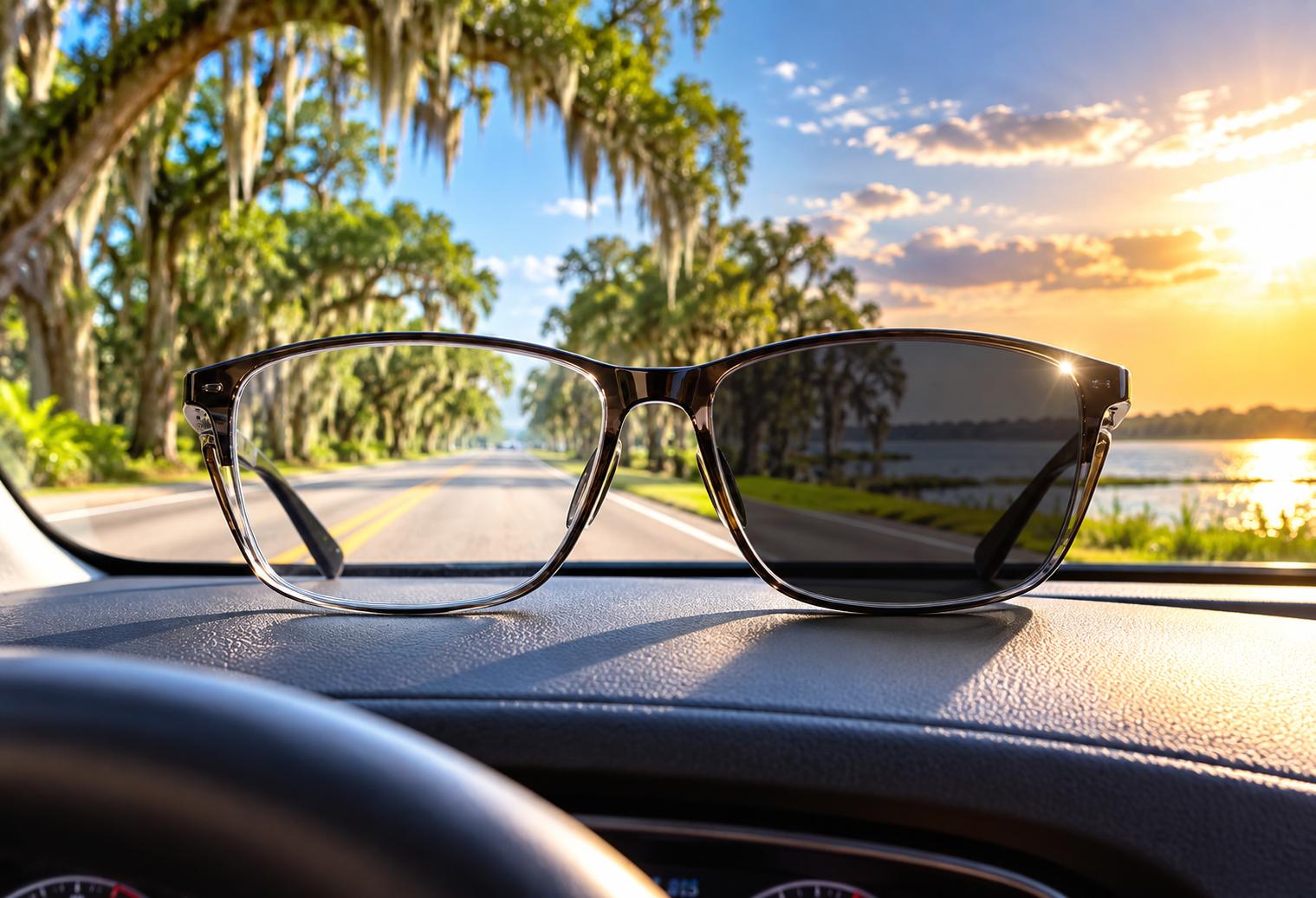
Louisiana drivers can move from bright sunshine to heavy cloud cover, shaded roads, and afternoon rain within the same trip. That changing light can make choosing comfortable everyday eyewear more complicated, especially if you regularly drive between Hammond, Ponchatoula, Baton Rouge, and other Southeast Louisiana communities.
Quick answer: Photochromic lenses are eyeglass lenses that automatically darken when exposed to certain types of light, especially ultraviolet light, and become clearer when that exposure decreases. They can be convenient for Louisiana residents who frequently move between indoor and outdoor environments. However, standard photochromic lenses may not become as dark inside a vehicle because windshields block much of the UV light that activates them. Drivers should consider their typical routes, glare sensitivity, and time spent behind the wheel before choosing them.
What Louisiana Drivers Should Know
-
Photochromic lenses automatically adjust their tint instead of requiring you to switch between regular glasses and sunglasses.
-
Standard versions may darken less inside a vehicle because automotive windshields filter much of the UV light used to activate the lenses.
-
Louisiana’s bright outdoor conditions can make light-responsive lenses useful when moving between indoor spaces, parking lots, sidewalks, and vehicles.
-
Drivers traveling around Tangipahoa Parish may still prefer dedicated prescription sunglasses when strong daytime glare is their primary concern.
-
Different photochromic lens technologies respond differently, so lens selection should account for driving habits rather than convenience alone.
What Are Photochromic Lenses?
Photochromic lenses are light-responsive eyeglass lenses that darken outdoors and return toward a clearer state when the activating light decreases. For Louisiana residents, that means one pair of glasses can provide clearer indoor vision and a darker tint outdoors without requiring a constant switch between prescription glasses and sunglasses.
The lenses contain photochromic molecules that react to light. Their darkness can vary based on the lens technology, temperature, available light, and other environmental conditions.
That flexibility can be particularly convenient for someone who spends the day moving between an office, vehicle, stores, job sites, and outdoor areas.
Tangi Vision Outlet can help local eyewear shoppers compare lens choices based on how and where they actually wear their glasses. After the first question of prescription and frame selection, we believe driving habits are an important part of the lens conversation.
Why Do Photochromic Lenses Matter for Louisiana Drivers?
Photochromic lenses matter for Louisiana drivers because changing light conditions are part of everyday life across Southeast Louisiana, but driving presents a special limitation for traditional photochromic technology. A lens that becomes noticeably dark outdoors may remain considerably lighter when you are sitting behind a UV-filtering windshield.
That distinction matters on routes through Hammond, Ponchatoula, Amite, and surrounding Tangipahoa Parish communities.
Bright open roads can create very different visual conditions from tree-covered streets or heavily developed areas. Drivers may also encounter rapidly changing conditions when afternoon clouds and rain move through the region.
The National Weather Service’s New Orleans/Baton Rouge office documents the area’s warm climate and substantial rainfall. Those regional conditions help explain why eyewear that works comfortably across changing environments can be valuable.
Do Photochromic Lenses Get Dark Inside a Car?
Standard photochromic lenses generally do not become as dark inside a car as they do outdoors because most windshields block much of the ultraviolet light that activates traditional photochromic lenses. Some newer lens technologies are designed to respond to a broader range of light and may provide more tint behind the windshield.
This is one of the most important points for Louisiana drivers to understand.
Someone who expects photochromic glasses to behave exactly like dark sunglasses during a midday drive may be disappointed with some lens types. Side windows, windshield characteristics, temperature, lens technology, and the direction of sunlight can also affect the experience.
For people who spend hours driving on I-12, I-55, US 51, or other area roads, discussing in-car performance before choosing lenses is worthwhile.
What Are the Signs Photochromic Lenses May Fit Your Lifestyle?
Photochromic lenses may fit your lifestyle if you frequently move between indoor and outdoor environments and value convenience more than having the darkest possible tint every time you drive. Louisiana residents should consider their daily routine, commute, outdoor exposure, and sensitivity to bright conditions before deciding.
They may be worth considering if you:
-
Regularly forget to bring separate sunglasses.
-
Frequently walk between indoor and outdoor spaces.
-
Want prescription eyewear that adjusts automatically outdoors.
-
Spend part of the workday outside but do not want to carry two pairs.
-
Frequently run errands around Hammond or other nearby communities.
-
Prefer a versatile everyday lens over constantly changing glasses.
-
Want UV protection incorporated into your everyday eyewear.
Drivers whose biggest concern is strong glare behind the windshield may want to compare other options as well.
When Should You Ask an Eye Care Professional About Lens Options?
You should discuss lens options with an eye care professional when glare, changing light, your prescription, or your driving routine makes it difficult to choose between photochromic lenses and dedicated sunglasses. Professional guidance can help you understand how different lens technologies behave rather than assuming every light-responsive lens performs identically.
At our optical shop, we can discuss how you expect to use your glasses and explain available lens options without assuming one solution fits every Louisiana driver.
Bring up details such as how long your commute is, whether you drive mostly during daylight, how much time you spend outdoors, and whether you already own prescription sunglasses.
What Common Louisiana Conditions Affect Your Choice?
Bright daylight, heat, frequent cloud changes, rain, and time spent transitioning between indoor and outdoor spaces can all influence how useful photochromic lenses feel in Louisiana. The best choice depends less on the label on the lens and more on the environments where you need comfortable vision throughout a typical day.
National Weather Service climate normals show average summer high temperatures around 90°F or higher in the Baton Rouge and New Orleans region. Temperature can affect the behavior of some photochromic technologies, making it another factor worth discussing when comparing lenses.
Regional driving also varies. A commute along I-12 may involve extended exposure to open daylight, while local trips through Hammond or Ponchatoula can involve repeated transitions between shaded streets, parking areas, stores, and other buildings.
How Can You Get Better Results From Photochromic Lenses?
You can get better results from photochromic lenses by choosing the technology according to your actual routine and understanding its limitations before ordering. Louisiana drivers should specifically ask about outdoor darkness, activation behind a windshield, fade-back time, lens color, coatings, and whether a separate pair of sunglasses would still be useful.
Keep your lenses clean so fingerprints, dust, and residue do not interfere with clear vision. Use lens-safe cleaning materials rather than household cleaners that may damage coatings.
Most importantly, do not choose photochromic lenses solely because you expect them to replace every type of sunglass. Their strength is convenience across changing environments. A dedicated sunglass can still be useful for certain driving and outdoor situations.
What Results Should You Expect From Photochromic Lenses?
You should expect photochromic lenses to provide automatic tint adjustment as lighting changes, not instant transformation into dark driving sunglasses under every condition. Outdoors, compatible lenses can become noticeably darker, while indoors they generally return toward a clearer state over time.
The exact speed and degree of change vary by product and environmental conditions.
For many Tangipahoa Parish residents, the main benefit is simplicity. You can leave a building wearing clear or nearly clear prescription glasses and have those same lenses respond as you step outdoors.
Behind the wheel, expectations should be different because of the windshield effect.
What Mistakes Should Louisiana Drivers Avoid?
Louisiana drivers should avoid assuming all photochromic lenses perform the same way or that any photochromic lens will completely replace prescription sunglasses behind the wheel. Comparing lens performance with your actual driving needs is a better approach than selecting lenses based only on their ability to change tint.
Mistake: Expecting maximum darkness inside the vehicle.
Consequence: The lenses may stay lighter than expected behind a UV-blocking windshield.
Better approach: Ask specifically about in-car activation before ordering.
Mistake: Choosing based only on outdoor appearance.
Consequence: You may overlook how quickly the lenses clear when you return indoors.
Better approach: Compare both activation and fade-back characteristics.
Mistake: Ignoring your primary driving conditions.
Consequence: A convenient everyday lens may not address your strongest daytime glare concerns.
Better approach: Discuss photochromic lenses alongside prescription sunglasses and other sun-lens options.
What Is a Common Local Driving Scenario?
A common local scenario is a Hammond-area resident leaving home in bright morning conditions, driving to work, moving between indoor and outdoor spaces during the day, and then encountering clouds or rain on the afternoon commute. Photochromic lenses can reduce the need to repeatedly change glasses during those transitions.
The limitation appears once the driver gets behind the windshield. Depending on the lens technology, the lenses may lighten even though conditions outside the vehicle still feel bright.
For that driver, the right solution could be photochromic lenses, dedicated prescription sunglasses, or having both available for different situations.
What Eyewear Options Can Address Changing Light and Driving Glare?
Eyewear options for changing Louisiana light include photochromic lenses, prescription sunglasses, polarized sun lenses, and other lens technologies designed for different levels of light exposure. The right solution depends on whether your priority is everyday convenience, strong sun protection, driving comfort, outdoor activities, or a combination of these needs.
We can help you compare available options based on your prescription and daily routine.
How Do Photochromic Lenses Compare With Prescription Sunglasses?
Photochromic lenses prioritize automatic adjustment and convenience, while prescription sunglasses provide a consistent sunglass tint and can be selected specifically for bright outdoor and daytime driving conditions. Neither option is automatically right for every Louisiana resident, so the practical choice depends on when and where you need the glasses.
Photochromic lenses reduce the need to carry a second pair during routine transitions. Prescription sunglasses require switching glasses, but they provide predictable tint behind a vehicle windshield.
Some residents choose both. They use photochromic lenses as their everyday glasses and keep prescription sunglasses available for long daytime drives or outdoor activities.
What Areas Can Local Drivers Consider These Lens Options For?
Drivers throughout Tangipahoa Parish and surrounding Southeast Louisiana communities can consider photochromic lenses when choosing everyday prescription eyewear. That includes residents traveling through Hammond, Ponchatoula, Amite, Independence, and nearby areas, as well as commuters regularly heading toward Baton Rouge, Covington, or the Northshore.
Your normal route and daily activities provide useful context when comparing lenses.
What Can Happen If You Choose the Wrong Lens for Your Driving Needs?
Choosing a lens without considering your driving needs can leave you with eyewear that is convenient in one environment but less suited to another. For example, a Louisiana driver may enjoy photochromic performance outdoors yet discover that the tint behind the windshield is lighter than expected during bright daytime travel.
That does not mean the lenses are defective. It may simply reflect how that particular technology activates.
Discussing your routine before ordering can help set realistic expectations and identify whether another sun-lens option should also be considered.
FAQ About Photochromic Lenses for Louisiana Drivers
Are photochromic lenses good for driving in Louisiana?
Photochromic lenses can be useful for Louisiana drivers who want convenient eyewear throughout the day, but standard versions may not become very dark behind a windshield. If driving glare is your main concern, compare their in-car performance with dedicated prescription sunglasses or other lens options before choosing.
Why don’t my photochromic lenses get very dark in the car?
Photochromic lenses may stay lighter in a car because the windshield blocks much of the ultraviolet light that activates traditional photochromic technology. The amount of tint can vary by product and conditions, which is why Louisiana drivers should ask specifically about behind-the-windshield performance.
Are photochromic lenses useful in Hammond?
Photochromic lenses can be useful in Hammond for residents who frequently move between indoor and outdoor environments throughout the day. They can be especially convenient for errands, work, and other activities involving repeated light changes, although drivers should understand that windshield performance can differ from full outdoor activation.
Will Louisiana heat affect photochromic lenses?
Temperature can influence the behavior of some photochromic lens technologies, including how dark they become or how quickly they change. Because Southeast Louisiana experiences long periods of warm weather, it is useful to ask how the specific lens product you are considering performs under warmer conditions.
Are photochromic lenses the same as polarized sunglasses?
No, photochromic and polarized describe different lens features. Photochromic lenses change tint in response to light, while polarization is designed to reduce certain types of reflected glare. Louisiana drivers comparing sun protection should ask which features are available and whether they match their driving and outdoor activities.
Should Tangipahoa Parish commuters own separate sunglasses?
Separate sunglasses may be useful for Tangipahoa Parish commuters who regularly experience strong daytime glare and want a consistently dark lens behind the windshield. Photochromic lenses can still serve as convenient everyday eyewear, so some drivers prefer having both options rather than expecting one pair to cover every situation.
How quickly do photochromic lenses become clear indoors?
Photochromic lenses generally begin returning toward a clearer state after the activating light is reduced, but the exact transition time varies with the lens technology and environmental conditions. If quick transitions matter because you frequently enter stores, offices, or other buildings, ask about fade-back performance before selecting your lenses.
Can I get photochromic lenses with my prescription?
Photochromic technology is available with many prescription lens options, although suitability depends on the prescription, lens material, frame, and products available. We can review your eyewear needs and discuss which options are appropriate rather than assuming a particular photochromic product will work for every prescription.
Find Eyewear That Fits the Way You Drive in Louisiana
The best lens is one that works with your prescription, routine, and expectations. At Tangi Vision Outlet, we can help you understand your options so you know what to expect from your eyewear indoors, outdoors, and behind the wheel.
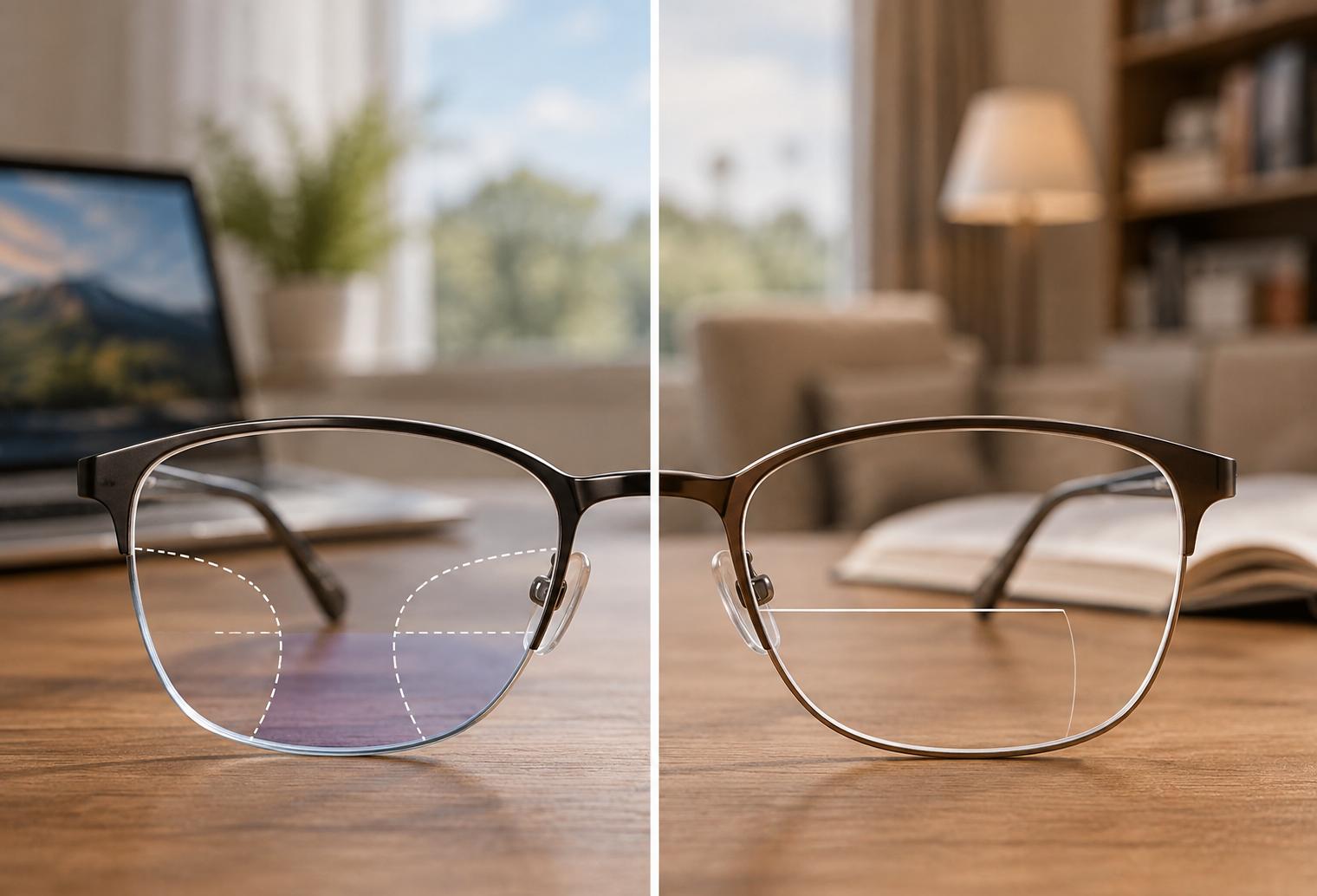
If reading a menu is getting harder but your distance vision still needs correction, one pair of glasses may need to handle more than one job. For adults in Hammond, LA, that can lead to a common question when choosing new eyewear: should you get progressive lenses or bifocals?
Progressive lenses provide a gradual change in prescription for distance, intermediate, and near vision without a visible dividing line. Bifocals use two distinct viewing areas, typically one for distance and another for near tasks. Both can help with presbyopia, the age-related loss of near focusing ability, but they provide noticeably different viewing experiences.
What Hammond Eyeglass Wearers Should Know
-
Progressive lenses provide multiple viewing distances with a gradual transition between powers.
-
Bifocals have separate distance and near-vision areas, usually divided by a visible line.
-
Progressive lenses can be especially useful when shifting between driving, computer work, and reading throughout the day.
-
Bifocals may appeal to Hammond residents who prefer clearly defined distance and reading zones.
-
Proper measurements and frame selection matter because the position of each viewing area affects how comfortably you use multifocal lenses.
Why Does the Difference Between Progressive Lenses and Bifocals Matter?
The difference between progressive lenses and bifocals matters because each design changes how you move between distance and near vision during everyday activities. Progressive lenses add an intermediate range between far and near vision, while traditional bifocals provide two distinct powers.
That distinction can become noticeable during a normal day around Tangipahoa Parish. Driving along I-12 or US 190 requires clear distance vision, while checking the dashboard involves an intermediate or closer viewing distance. At work, you may alternate between a computer screen, paperwork, and people across the room.
Tangi Vision Outlet helps local customers explore eyewear options based on their prescriptions and everyday visual needs. We can explain how different lens designs work and help you consider which option makes sense for your routine.
How Do Progressive Lenses Work?
Progressive lenses work by gradually changing lens power from the upper portion of the lens toward the lower portion, providing distance, intermediate, and near viewing areas. Unlike bifocals, there is no visible line separating those areas, so wearers move their gaze through different portions of the lens for different distances.
The intermediate zone is one of the biggest practical differences. It can be useful for computer screens, vehicle dashboards, store shelves, and other objects that are neither far away nor held at normal reading distance.
For someone who spends the morning working at a computer, drives across Hammond in the afternoon, and reads at home in the evening, that broader range can be convenient.
How Do Bifocals Work?
Bifocals work by placing two different lens powers in the same eyeglass lens, typically providing distance correction above and near correction below. The two areas have a defined transition rather than the gradual progression found in progressive lenses.
Looking straight ahead generally uses the distance portion. Looking downward through the reading segment allows the wearer to use the near prescription.
Some people appreciate this clearly defined separation because they know exactly where to look for close work. The tradeoff is that traditional bifocals do not provide the same gradual intermediate range available with progressives.
What Signs Suggest You May Need Multifocal Lenses?
Common signs that multifocal lenses may be worth discussing include increasing difficulty with close-up tasks while you still need clear vision at other distances. Presbyopia develops as the eye loses some of its ability to focus on nearby objects with age, making reading and other close work more difficult.
Signs can include:
-
Holding menus, books, or your phone farther away to see clearly
-
Needing more comfortable viewing for both near and distance tasks
-
Removing your current glasses to read
-
Switching frequently between reading glasses and distance glasses
-
Experiencing difficulty focusing on close print
-
Finding that computer distance falls awkwardly between your current viewing zones
-
Wanting one pair of glasses to cover more of your normal daily activities
A change in vision should not automatically be assumed to be presbyopia. Appropriate eye care can determine your prescription and whether another vision or eye-health issue needs attention.
Which Lens Is Better for Driving Around Hammond?
Progressive lenses may offer an advantage for drivers who want distance, intermediate, and near correction in one lens, while bifocals can still provide clear distance and close viewing zones. The right choice depends on your prescription, visual needs, previous eyewear experience, and comfort with each design.
Think about the range of distances involved during a drive through Hammond or toward Ponchatoula, Albany, or Robert. You may look far down the road, glance at the instrument panel, and read something closer after parking.
Progressives provide different powers across that range. Bifocals create a more distinct transition between far and near vision.
Any new multifocal lens can require some adjustment, so give yourself time to learn where the clearest viewing areas are before judging the new eyewear.
What Are the Most Common Reasons People Choose One Over the Other?
People commonly choose progressive lenses for their wider range of viewing distances and line-free appearance, while bifocals are often chosen for their distinct distance and reading areas. Neither design is automatically right for every eyeglass wearer.
Progressive lenses may make sense when:
You regularly use computers or other intermediate-distance objects, want one pair of glasses for several distances, or prefer lenses without a visible bifocal line.
Bifocals may make sense when:
Your primary needs are distance and close reading, you prefer a clearly defined near segment, or you are already comfortable using bifocals.
Daily habits matter. Someone working on a computer near Southeastern Louisiana University may have different visual demands than someone whose day consists primarily of driving and close paperwork.
How Can You Make Adjusting to New Multifocal Lenses Easier?
Adjusting to multifocal lenses is usually easier when you wear them consistently and learn to point your head and eyes toward the appropriate viewing zone. Progressive lenses in particular may feel different at first because different portions of the lens are designed for different distances.
Wear your new glasses as directed rather than constantly switching back to an older prescription. When looking at something, move your head naturally until you find the clearest area of the lens.
If something consistently seems wrong rather than simply unfamiliar, ask for help. Frame position, measurements, prescription details, and lens selection can all influence your experience.
What Mistakes Should Hammond Eyeglass Shoppers Avoid?
The biggest mistakes when comparing progressive lenses and bifocals are choosing based only on appearance or price and ignoring how the glasses will actually be used. Your normal viewing distances and daily routine should be central to the decision.
Mistake: Choosing progressives simply because they do not have a visible line.
Consequence: The lens design may not match your priorities.
Better approach: Consider your work, driving, reading, and computer habits first.
Mistake: Assuming bifocals and progressives provide the same viewing experience.
Consequence: You may be surprised by the intermediate range or transition between powers.
Better approach: Understand where each lens places distance, intermediate, and near correction.
Mistake: Giving up immediately on unfamiliar multifocal glasses.
Consequence: You may not allow enough time to become accustomed to using different lens zones.
Better approach: Follow the fitting guidance you receive and ask for assistance if problems persist.
A Common Hammond Scenario
A common local scenario is an adult who sees well enough at distance with prescription glasses but increasingly struggles with a phone, restaurant menu, paperwork, or computer screen. Switching glasses throughout the day becomes inconvenient, so multifocal lenses become worth considering.
Imagine commuting along I-12, working at a computer for several hours, stopping somewhere near downtown Hammond, and reading on your phone later that evening. Those tasks involve several viewing distances.
A bifocal could address far and near correction. A progressive lens could add a gradual intermediate range that may be useful for the computer and dashboard.
The best option depends on the individual prescription and how those glasses will actually be used.
What Eyewear Options Can Help With Presbyopia?
Eyewear options for presbyopia include reading glasses, bifocals, progressive lenses, and other forms of vision correction depending on the individual’s needs. The goal is to match correction to the distances that matter most in everyday life.
At Tangi Vision Outlet, we can help explain available eyewear choices and how lens and frame selection relate to your prescription and routine.
Progressive Lenses vs. Bifocals: Which Should You Choose?
Choose progressive lenses if you value a gradual range from distance through intermediate to near vision, while bifocals may be preferable if you want two clearly defined viewing areas. Your prescription, work environment, reading habits, driving needs, and previous experience with multifocal eyewear should guide the decision.
| Consideration |
Progressive Lenses |
Bifocals |
| Distance vision |
Yes |
Yes |
| Intermediate zone |
Yes |
Not a dedicated gradual zone |
| Near vision |
Yes |
Yes |
| Visible dividing line |
No |
Typically yes |
| Transition between powers |
Gradual |
Distinct |
| Computer-focused routines |
Intermediate zone may help |
May be less versatile for intermediate distance |
Rather than asking which design is universally better, ask which one better fits the distances you use most.
Where Can Local Residents Explore Their Eyewear Options?
Residents of Hammond and surrounding Tangipahoa Parish communities can compare lens options based on their individual prescriptions and everyday visual needs. People traveling from nearby Ponchatoula, Albany, Robert, or other parts of the Northshore region may have many of the same questions about choosing multifocal eyewear.
The important part is selecting glasses around your actual routine rather than simply choosing the lens type you have heard about most often.
What Happens If You Keep Struggling With the Wrong Eyewear?
Continuing to use eyewear that no longer meets your visual needs can make routine tasks unnecessarily difficult and may leave you frequently switching glasses or struggling at certain distances. Changes in vision also deserve appropriate evaluation rather than simply being dismissed as part of getting older.
If reading, computer work, or transitions between viewing distances have become frustrating, it may be time to revisit your prescription and eyewear choices.
Frequently Asked Questions About Progressive Lenses and Bifocals
Are progressive lenses better than bifocals?
Progressive lenses are not automatically better than bifocals, but they provide distance, intermediate, and near correction through a gradual change in lens power. Bifocals provide two distinct viewing zones. For Hammond wearers, the better choice depends on prescription needs, daily activities, and personal preference.
Do progressive lenses have a bifocal line?
No, progressive lenses do not have the visible dividing line associated with traditional bifocals. Their prescription changes gradually through different areas of the lens. This line-free design is one reason some Tangipahoa Parish eyeglass wearers prefer progressives, although appearance should not be the only factor in choosing lenses.
Can I use progressive lenses for computer work?
Yes, progressive lenses include an intermediate viewing area that can be useful for computer-distance tasks. The exact experience depends on the lens design, prescription, fitting, and working distance. Hammond residents who spend significant portions of the day at a computer should mention those habits when discussing eyewear options.
Are bifocals good for driving?
Bifocals can provide distance correction for looking at the road and a near segment for closer tasks. Because driving also involves intermediate-distance objects such as the dashboard, some Hammond drivers may prefer the broader range available from progressive lenses. Individual prescriptions and visual requirements should guide the choice.
Why do progressive lenses feel different at first?
Progressive lenses can feel different because lens power changes across the lens rather than switching between two fixed areas. Wearers need to learn which areas provide the clearest view at different distances. Consistent use can help with adaptation, while persistent difficulties should be discussed with an eye-care or eyewear professional.
Can I switch from bifocals to progressives?
Yes, many people can consider switching from bifocals to progressive lenses when their prescription and visual needs make progressives appropriate. The viewing experience will be different, so an adjustment period may be necessary. If you are considering a change in Hammond, discuss how you use your glasses throughout a typical day.
Do I need multifocal lenses just because close-up vision is getting blurry?
No, blurry near vision should not automatically be self-diagnosed as a need for multifocal lenses. Presbyopia commonly affects near focusing with age, but vision changes can have different causes. An appropriate vision assessment can identify your prescription needs and help determine which form of correction is suitable.
Where can I compare progressive lenses and bifocals in Hammond, LA?
Tangi Vision Outlet can help local eyewear shoppers understand the practical differences between progressive lenses and bifocals. We can discuss how lens options relate to your prescription, reading habits, computer use, driving, and other everyday visual demands so you can make a more informed eyewear choice.
Find a Better Fit for Your Everyday Vision in Hammond
Choosing between progressives and bifocals is easier when you focus on how you actually use your eyes throughout the day. Whether you are reading, working at a screen, driving around Tangipahoa Parish, or moving between all three, we can help you explore eyewear options designed around your prescription and routine.

Whether they are picking up a new pair of prescription glasses or simply refreshing their look with a fashion-forward frame, residents across Hammond are embracing designer eyewear like never before. Eye care has evolved far beyond just seeing clearly. Today, your frames are a statement, a reflection of your personality, and an extension of your personal style.
From bold oversized shapes to sleek minimalist silhouettes, here is a closer look at the designer eyewear trends that Hammond locals are loving this year.
The Rise of Retro Frames in Hammond, LA
Nostalgia is a powerful force in fashion, and it is showing up in a major way when it comes to trendy eyeglass frames. This year, retro-inspired styles are dominating the designer eyewear scene, and Hammond residents are fully on board. Think thick acetate frames in tortoiseshell patterns, rounded lenses reminiscent of the 1960s and 70s, and keyhole bridge designs that feel both vintage and fresh.
Browline frames, popularized decades ago, have made a massive comeback and are being spotted all over Hammond. These frames feature a bold upper rim that mimics the look of eyebrows sitting above the lens, creating a distinctive and intellectual aesthetic. Paired with modern lens technology, these classic silhouettes offer the best of both worlds: a timeless look with all the benefits of contemporary prescription glasses.
Local eye care providers in Hammond, LA are reporting strong demand for these retro-inspired styles, especially among younger customers who want to stand out from the crowd. The appeal is easy to understand. There is something deeply satisfying about wearing a frame that feels both nostalgic and cutting-edge at the same time.
Oversized and Bold: Making a Statement With Stylish Eyeglasses in Hammond
If subtle is not your style, you are in good company. Oversized frames have taken the designer eyewear world by storm, and the trend has firmly landed in Hammond. Large square frames, wide rectangular silhouettes, and chunky geometric shapes are all having a moment, and residents here are leaning into these bold choices with enthusiasm.
Oversized frames do more than just turn heads. They offer practical benefits as well, including a wider field of vision and added protection from sunlight and environmental elements. For those who wear prescription glasses in Hammond, LA, opting for a larger frame can also mean a more comfortable fit for stronger prescriptions, since the lens has more room to accommodate the correction.
Color is another dimension driving this trend. Deep emerald greens, rich burgundies, translucent blush tones, and even two-tone combinations are making stylish eyeglasses in Hammond far more exciting than the standard black or brown frames of years past. Whether you prefer something understated in a soft neutral or a frame that practically announces your arrival, the oversized category has something for every personality.
Eye care professionals in Hammond, LA are encouraging patients to think of their eyeglasses as accessories rather than medical necessities. Once you start approaching your frames that way, choosing a bold oversized pair becomes a lot less intimidating and a whole lot more fun.
Lightweight and Minimalist Frames for the Modern Hammond Resident
Not everyone wants their glasses to do all the talking, and that is perfectly valid. On the opposite end of the spectrum from oversized and bold, the minimalist frame trend is equally popular among Hammond residents who prefer a cleaner, more understated aesthetic.
Ultra-thin metal frames in gold, silver, and rose gold have become a go-to for professionals and style-conscious individuals who want their prescription glasses to complement their look without overpowering it. These frames work beautifully across a wide range of face shapes and personal styles, making them one of the most versatile options in designer eyewear today.
Titanium frames have also gained significant traction in Hammond, LA this year. Titanium is prized for being incredibly lightweight while remaining highly durable, making it an excellent material for everyday wear. For people who spend long hours in their glasses, the comfort of a titanium frame is genuinely hard to beat.
Rimless and semi-rimless designs are another minimalist option gaining ground. These frames create an almost-invisible effect, allowing your facial features to take center stage while still delivering the vision correction you need. Patients visiting eye care providers in Hammond who prioritize comfort and a polished professional appearance tend to gravitate toward these sleek, refined options.
Sustainable and Eco-Friendly Designer Eyewear Gaining Ground in Hammond
One of the most meaningful shifts in the designer eyewear industry over the past few years has been the growing emphasis on sustainability, and Hammond residents are paying attention. Eco-conscious consumers are increasingly seeking out frames made from recycled materials, bio-based acetate, and responsibly sourced wood or bamboo.
Several leading designer eyewear brands have responded to this demand by rolling out collections that prioritize environmental responsibility without sacrificing style. Frames crafted from recycled ocean plastics, for example, are becoming more accessible and are showing up in eye care practices across Hammond, LA. These glasses often feature the same quality construction and stylish design as their conventional counterparts, making it easy for shoppers to make a more sustainable choice.
Bio-acetate frames deserve special mention here. Made from plant-based materials rather than petroleum-derived plastics, bio-acetate offers the same rich colors and smooth finish that have made acetate frames a perennial favorite. For Hammond residents who want trendy eyeglass frames without the environmental guilt, bio-acetate is a compelling option.
The sustainability trend also extends to packaging, with many brands eliminating single-use plastics in favor of recycled cardboard and reusable cases. For Hammond shoppers who want their values reflected in every purchasing decision, the growing availability of eco-friendly designer eyewear is a welcome development.
Blue Light and Transition Lenses: Functional Meets Fashionable in Hammond Eye Care
Trendy eyeglass frames are only part of the picture. Lens technology has also taken major strides forward, and Hammond residents are embracing functional upgrades that enhance both vision and lifestyle. Two of the biggest lens trends this year are blue light filtering lenses and photochromic (transition) lenses, and both are becoming standard requests at eye care offices in Hammond, LA.
Blue light filtering lenses have become especially popular among remote workers, students, and anyone who spends extended time in front of screens. These lenses are designed to reduce exposure to the high-energy visible light emitted by phones, tablets, and computers, which many people associate with eye strain, headaches, and disrupted sleep. Whether you are working long hours from home or scrolling through your phone late at night, blue light lenses offer a layer of protection that is easy to integrate into your prescription glasses.
Transition lenses, which automatically darken in response to sunlight and return to clear indoors, continue to be a popular choice for Hammond residents who want the convenience of sunglasses without carrying a separate pair. Advances in transition technology have made these lenses faster and more responsive than ever, and they are now available in a wider range of tints and frame styles, making them a genuinely fashionable option.
The intersection of function and fashion is where modern eye care truly shines, and Hammond providers are well-positioned to help patients find the perfect combination of style and performance in their next pair of designer eyewear.
Conclusion
Hammond, LA has become a surprisingly vibrant hub for designer eyewear trends, with residents embracing everything from bold retro frames to sustainable materials and smart lens technology. Whether you are in the market for stylish eyeglasses or simply due for an eye care checkup, now is a great time to explore what the world of prescription glasses in Hammond, LA has to offer. Your next favorite pair of frames might be closer than you think.
Need Optometry Services Near You?
Here at Tangi Vision Outlet, we’re passionate about helping you see the world clearly and comfortably! For over 10 years, our family-owned business in Hammond, Louisiana, led by Dr. Stephen E. Warren, has been dedicated to providing top-notch optometry services and custom eyewear tailored to your needs. With our cost-effective solutions, unmatched customer service, and a one-year, no-hassle scratch warranty on all products, we’re here to make your experience stress-free and satisfying. Walk in any day, even Saturdays, to see a doctor on staff—no appointment necessary. Reach out to us today and let us help you find your perfect pair of glasses!

Many people today spend hours staring at screens, whether for work, entertainment, or social media. This constant exposure to electronic devices has led to a growing concern about blue light and its potential effects on our eyes and sleep patterns. Blue light glasses have emerged as a popular solution, with manufacturers claiming they can reduce eye strain and improve sleep quality. But do these trendy eyeglasses actually deliver on their promises?
If you are looking for a blue light glasses solution in Hammond, LA, or need to consult with an eye doctor in Hammond, LA, this guide will help you understand the science behind these glasses and whether they are worth the investment.
Understanding Blue Light and Its Sources
Blue light is a type of visible light with a short wavelength and high energy. It exists naturally in sunlight, but it is also emitted by digital screens such as computers, smartphones, tablets, and televisions. Our exposure to blue light has increased significantly over the past decade as screen time becomes an integral part of daily life for most people.
The concern about blue light stems from the belief that it can penetrate deep into the eye and potentially cause damage to the retina. Additionally, some research suggests that blue light exposure, particularly in the evening, can interfere with the body’s natural circadian rhythm and melatonin production, which regulates sleep. This has prompted many manufacturers to develop blue light glasses specifically designed to filter out some of this light before it reaches your eyes.
When you search for digital eye strain relief in Hammond, you will find numerous options, including blue light blocking eyeglasses. However, understanding how these glasses work and whether the science supports their effectiveness is important before making a purchase decision.
What the Science Says About Blue Light Glasses
The scientific community remains somewhat divided on the effectiveness of blue light glasses. While some studies suggest that blue light glasses can provide modest benefits, the evidence is not conclusive. Several research papers have examined the impact of blue light glasses on eye strain and sleep quality, with mixed results.
One key finding from research is that digital eye strain, also known as computer vision syndrome, is likely caused more by the behavior of people while using screens rather than by blue light itself. People tend to blink less frequently when looking at screens, which leads to dry eyes and discomfort. Additionally, poor ergonomics, inadequate lighting, and the effort required to focus on screens at close distances all contribute to eye strain.
Some studies have shown that blue light glasses can help reduce eye strain symptoms in certain individuals, particularly those who spend extended periods in front of screens. However, other research suggests that the benefits may be placebo effects or that the relief comes from the reduced screen time rather than from the glasses themselves.
If you are experiencing digital eye strain relief needs in Hammond, consulting with an eye doctor in Hammond, LA, is a practical step. A professional eye care provider can evaluate your specific situation and recommend whether blue light glasses would be beneficial for your circumstances.
Preventing Digital Eye Strain: Alternative Solutions
Before investing in blue light glasses, it is worth considering other proven methods for reducing digital eye strain. These approaches are supported by stronger scientific evidence and may be more effective for many people.
The 20-20-20 rule is one of the most recommended strategies by eye care professionals. This rule suggests that for every 20 minutes of screen time, you should take a 20-second break and look at something 20 feet away. This simple practice helps relax the focusing muscles in your eyes and reduces strain significantly.
Adjusting your workspace ergonomics is another important consideration. Your screen should be positioned at arm’s length away from your eyes, with the top of the screen at or slightly below eye level. Proper lighting in your workspace can also reduce glare and strain. Additionally, using an anti-glare screen protector on your devices may help.
Increasing humidity in your environment and using artificial tears can address the dry eye problem that often accompanies screen use. These strategies are often overlooked but can provide substantial relief without the need for special eyeglasses. An eye doctor in Hammond, LA, can provide specific recommendations tailored to your individual needs and work environment.
Are Blue Light Glasses Worth the Investment?
The question of whether blue light glasses are worth purchasing ultimately depends on your individual needs and preferences. These glasses typically cost between 50 and 300 dollars, depending on the brand and lens quality. Some people report feeling significant relief from eye strain and improved sleep quality after wearing blue light glasses, while others notice minimal difference.
If you spend more than six hours per day in front of screens and experience regular eye discomfort, blue light glasses might be worth trying. Since they are generally affordable and non-invasive, testing them out may help you determine if they provide personal benefits. However, if you are primarily concerned about digital eye strain relief in Hammond, combining blue light glasses with other proven strategies like the 20-20-20 rule and ergonomic adjustments is likely to be more effective.
It is also important to note that blue light glasses should not be viewed as a replacement for professional eye care. If you are experiencing persistent eye problems, visiting an eye doctor in Hammond, LA, is essential to rule out underlying conditions like astigmatism, presbyopia, or other refractive errors.
Consulting a Professional Eye Doctor in Hammond, LA
When considering blue light glasses, consulting with a professional is always a wise decision. An eye doctor in Hammond, LA, can conduct a comprehensive eye examination and provide personalized recommendations based on your vision needs and lifestyle.
During an eye exam, your eye doctor can determine whether your eye strain is related to blue light exposure or caused by other factors such as uncorrected vision problems or dry eyes. They can also recommend the best combination of treatments for your specific situation.
Additionally, an eye doctor can prescribe blue light filtering lenses that are customized to your prescription, which may be more effective than over-the-counter blue light glasses. Some eye doctors recommend blue light blocking coatings added to regular prescription lenses, which provides the dual benefit of vision correction and blue light filtration.
If you are located in Hammond, LA, and are interested in learning more about blue light glasses or experiencing digital eye strain relief, scheduling an appointment with a local eye care professional is your best option. They can provide evidence-based advice and help you make an informed decision about whether these glasses are appropriate for your needs.
Conclusion
Blue light glasses have become increasingly popular as a solution for digital eye strain, but the scientific evidence supporting their effectiveness remains mixed. While some individuals report benefits from wearing them, other evidence suggests that the relief may come from behavioral changes or placebo effects. Rather than relying solely on blue light glasses, a comprehensive approach that includes the 20-20-20 rule, ergonomic adjustments, and regular eye care appointments is more likely to provide effective digital eye strain relief in Hammond. Consulting with an eye doctor in Hammond, LA, can help you determine the best strategy for your unique situation and whether blue light glasses are a worthwhile addition to your eye care routine.
Need Optometry Services Near You?
Here at Tangi Vision Outlet, we’re passionate about helping you see the world clearly and comfortably! For over 10 years, our family-owned business in Hammond, Louisiana, led by Dr. Stephen E. Warren, has been dedicated to providing top-notch optometry services and custom eyewear tailored to your needs. With our cost-effective solutions, unmatched customer service, and a one-year, no-hassle scratch warranty on all products, we’re here to make your experience stress-free and satisfying. Walk in any day, even Saturdays, to see a doctor on staff—no appointment necessary. Reach out to us today and let us help you find your perfect pair of glasses!