

What Are Photochromic Lenses and Are They Right for Louisiana Drivers?
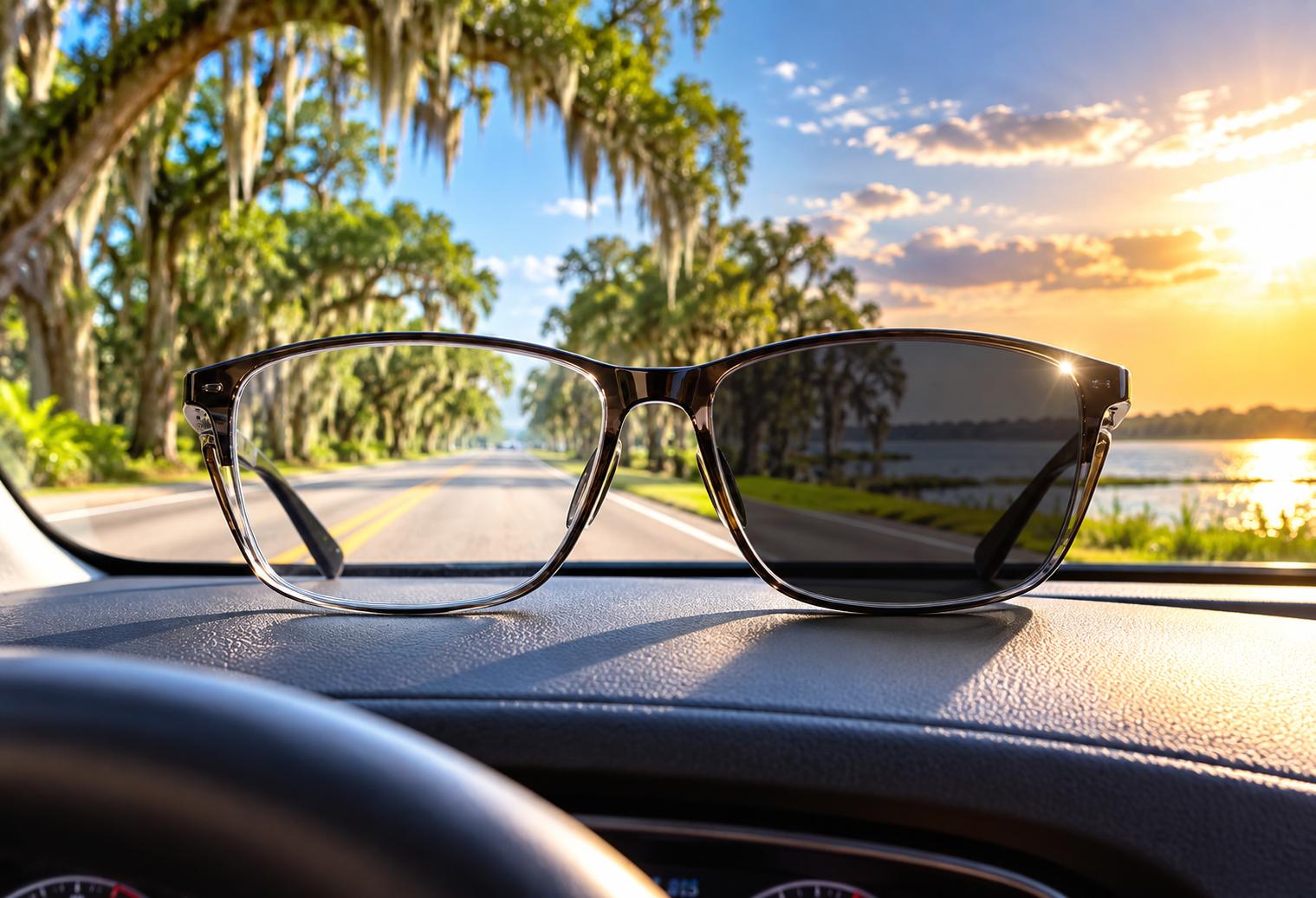
Louisiana drivers can move from bright sunshine to heavy cloud cover, shaded roads, and afternoon rain within the same trip. That changing light can make choosing comfortable everyday eyewear more complicated, especially if you regularly drive between Hammond, Ponchatoula, Baton Rouge, and other Southeast Louisiana communities.
Quick answer: Photochromic lenses are eyeglass lenses that automatically darken when exposed to certain types of light, especially ultraviolet light, and become clearer when that exposure decreases. They can be convenient for Louisiana residents who frequently move between indoor and outdoor environments. However, standard photochromic lenses may not become as dark inside a vehicle because windshields block much of the UV light that activates them. Drivers should consider their typical routes, glare sensitivity, and time spent behind the wheel before choosing them.
What Louisiana Drivers Should Know
-
Photochromic lenses automatically adjust their tint instead of requiring you to switch between regular glasses and sunglasses.
-
Standard versions may darken less inside a vehicle because automotive windshields filter much of the UV light used to activate the lenses.
-
Louisiana’s bright outdoor conditions can make light-responsive lenses useful when moving between indoor spaces, parking lots, sidewalks, and vehicles.
-
Drivers traveling around Tangipahoa Parish may still prefer dedicated prescription sunglasses when strong daytime glare is their primary concern.
-
Different photochromic lens technologies respond differently, so lens selection should account for driving habits rather than convenience alone.
What Are Photochromic Lenses?
Photochromic lenses are light-responsive eyeglass lenses that darken outdoors and return toward a clearer state when the activating light decreases. For Louisiana residents, that means one pair of glasses can provide clearer indoor vision and a darker tint outdoors without requiring a constant switch between prescription glasses and sunglasses.
The lenses contain photochromic molecules that react to light. Their darkness can vary based on the lens technology, temperature, available light, and other environmental conditions.
That flexibility can be particularly convenient for someone who spends the day moving between an office, vehicle, stores, job sites, and outdoor areas.
Tangi Vision Outlet can help local eyewear shoppers compare lens choices based on how and where they actually wear their glasses. After the first question of prescription and frame selection, we believe driving habits are an important part of the lens conversation.
Why Do Photochromic Lenses Matter for Louisiana Drivers?
Photochromic lenses matter for Louisiana drivers because changing light conditions are part of everyday life across Southeast Louisiana, but driving presents a special limitation for traditional photochromic technology. A lens that becomes noticeably dark outdoors may remain considerably lighter when you are sitting behind a UV-filtering windshield.
That distinction matters on routes through Hammond, Ponchatoula, Amite, and surrounding Tangipahoa Parish communities.
Bright open roads can create very different visual conditions from tree-covered streets or heavily developed areas. Drivers may also encounter rapidly changing conditions when afternoon clouds and rain move through the region.
The National Weather Service’s New Orleans/Baton Rouge office documents the area’s warm climate and substantial rainfall. Those regional conditions help explain why eyewear that works comfortably across changing environments can be valuable.
Do Photochromic Lenses Get Dark Inside a Car?
Standard photochromic lenses generally do not become as dark inside a car as they do outdoors because most windshields block much of the ultraviolet light that activates traditional photochromic lenses. Some newer lens technologies are designed to respond to a broader range of light and may provide more tint behind the windshield.
This is one of the most important points for Louisiana drivers to understand.
Someone who expects photochromic glasses to behave exactly like dark sunglasses during a midday drive may be disappointed with some lens types. Side windows, windshield characteristics, temperature, lens technology, and the direction of sunlight can also affect the experience.
For people who spend hours driving on I-12, I-55, US 51, or other area roads, discussing in-car performance before choosing lenses is worthwhile.
What Are the Signs Photochromic Lenses May Fit Your Lifestyle?
Photochromic lenses may fit your lifestyle if you frequently move between indoor and outdoor environments and value convenience more than having the darkest possible tint every time you drive. Louisiana residents should consider their daily routine, commute, outdoor exposure, and sensitivity to bright conditions before deciding.
They may be worth considering if you:
-
Regularly forget to bring separate sunglasses.
-
Frequently walk between indoor and outdoor spaces.
-
Want prescription eyewear that adjusts automatically outdoors.
-
Spend part of the workday outside but do not want to carry two pairs.
-
Frequently run errands around Hammond or other nearby communities.
-
Prefer a versatile everyday lens over constantly changing glasses.
-
Want UV protection incorporated into your everyday eyewear.
Drivers whose biggest concern is strong glare behind the windshield may want to compare other options as well.
When Should You Ask an Eye Care Professional About Lens Options?
You should discuss lens options with an eye care professional when glare, changing light, your prescription, or your driving routine makes it difficult to choose between photochromic lenses and dedicated sunglasses. Professional guidance can help you understand how different lens technologies behave rather than assuming every light-responsive lens performs identically.
At our optical shop, we can discuss how you expect to use your glasses and explain available lens options without assuming one solution fits every Louisiana driver.
Bring up details such as how long your commute is, whether you drive mostly during daylight, how much time you spend outdoors, and whether you already own prescription sunglasses.
What Common Louisiana Conditions Affect Your Choice?
Bright daylight, heat, frequent cloud changes, rain, and time spent transitioning between indoor and outdoor spaces can all influence how useful photochromic lenses feel in Louisiana. The best choice depends less on the label on the lens and more on the environments where you need comfortable vision throughout a typical day.
National Weather Service climate normals show average summer high temperatures around 90°F or higher in the Baton Rouge and New Orleans region. Temperature can affect the behavior of some photochromic technologies, making it another factor worth discussing when comparing lenses.
Regional driving also varies. A commute along I-12 may involve extended exposure to open daylight, while local trips through Hammond or Ponchatoula can involve repeated transitions between shaded streets, parking areas, stores, and other buildings.
How Can You Get Better Results From Photochromic Lenses?
You can get better results from photochromic lenses by choosing the technology according to your actual routine and understanding its limitations before ordering. Louisiana drivers should specifically ask about outdoor darkness, activation behind a windshield, fade-back time, lens color, coatings, and whether a separate pair of sunglasses would still be useful.
Keep your lenses clean so fingerprints, dust, and residue do not interfere with clear vision. Use lens-safe cleaning materials rather than household cleaners that may damage coatings.
Most importantly, do not choose photochromic lenses solely because you expect them to replace every type of sunglass. Their strength is convenience across changing environments. A dedicated sunglass can still be useful for certain driving and outdoor situations.
What Results Should You Expect From Photochromic Lenses?
You should expect photochromic lenses to provide automatic tint adjustment as lighting changes, not instant transformation into dark driving sunglasses under every condition. Outdoors, compatible lenses can become noticeably darker, while indoors they generally return toward a clearer state over time.
The exact speed and degree of change vary by product and environmental conditions.
For many Tangipahoa Parish residents, the main benefit is simplicity. You can leave a building wearing clear or nearly clear prescription glasses and have those same lenses respond as you step outdoors.
Behind the wheel, expectations should be different because of the windshield effect.
What Mistakes Should Louisiana Drivers Avoid?
Louisiana drivers should avoid assuming all photochromic lenses perform the same way or that any photochromic lens will completely replace prescription sunglasses behind the wheel. Comparing lens performance with your actual driving needs is a better approach than selecting lenses based only on their ability to change tint.
Mistake: Expecting maximum darkness inside the vehicle.
Consequence: The lenses may stay lighter than expected behind a UV-blocking windshield.
Better approach: Ask specifically about in-car activation before ordering.
Mistake: Choosing based only on outdoor appearance.
Consequence: You may overlook how quickly the lenses clear when you return indoors.
Better approach: Compare both activation and fade-back characteristics.
Mistake: Ignoring your primary driving conditions.
Consequence: A convenient everyday lens may not address your strongest daytime glare concerns.
Better approach: Discuss photochromic lenses alongside prescription sunglasses and other sun-lens options.
What Is a Common Local Driving Scenario?
A common local scenario is a Hammond-area resident leaving home in bright morning conditions, driving to work, moving between indoor and outdoor spaces during the day, and then encountering clouds or rain on the afternoon commute. Photochromic lenses can reduce the need to repeatedly change glasses during those transitions.
The limitation appears once the driver gets behind the windshield. Depending on the lens technology, the lenses may lighten even though conditions outside the vehicle still feel bright.
For that driver, the right solution could be photochromic lenses, dedicated prescription sunglasses, or having both available for different situations.
What Eyewear Options Can Address Changing Light and Driving Glare?
Eyewear options for changing Louisiana light include photochromic lenses, prescription sunglasses, polarized sun lenses, and other lens technologies designed for different levels of light exposure. The right solution depends on whether your priority is everyday convenience, strong sun protection, driving comfort, outdoor activities, or a combination of these needs.
We can help you compare available options based on your prescription and daily routine.
How Do Photochromic Lenses Compare With Prescription Sunglasses?
Photochromic lenses prioritize automatic adjustment and convenience, while prescription sunglasses provide a consistent sunglass tint and can be selected specifically for bright outdoor and daytime driving conditions. Neither option is automatically right for every Louisiana resident, so the practical choice depends on when and where you need the glasses.
Photochromic lenses reduce the need to carry a second pair during routine transitions. Prescription sunglasses require switching glasses, but they provide predictable tint behind a vehicle windshield.
Some residents choose both. They use photochromic lenses as their everyday glasses and keep prescription sunglasses available for long daytime drives or outdoor activities.
What Areas Can Local Drivers Consider These Lens Options For?
Drivers throughout Tangipahoa Parish and surrounding Southeast Louisiana communities can consider photochromic lenses when choosing everyday prescription eyewear. That includes residents traveling through Hammond, Ponchatoula, Amite, Independence, and nearby areas, as well as commuters regularly heading toward Baton Rouge, Covington, or the Northshore.
Your normal route and daily activities provide useful context when comparing lenses.
What Can Happen If You Choose the Wrong Lens for Your Driving Needs?
Choosing a lens without considering your driving needs can leave you with eyewear that is convenient in one environment but less suited to another. For example, a Louisiana driver may enjoy photochromic performance outdoors yet discover that the tint behind the windshield is lighter than expected during bright daytime travel.
That does not mean the lenses are defective. It may simply reflect how that particular technology activates.
Discussing your routine before ordering can help set realistic expectations and identify whether another sun-lens option should also be considered.
FAQ About Photochromic Lenses for Louisiana Drivers
Are photochromic lenses good for driving in Louisiana?
Photochromic lenses can be useful for Louisiana drivers who want convenient eyewear throughout the day, but standard versions may not become very dark behind a windshield. If driving glare is your main concern, compare their in-car performance with dedicated prescription sunglasses or other lens options before choosing.
Why don’t my photochromic lenses get very dark in the car?
Photochromic lenses may stay lighter in a car because the windshield blocks much of the ultraviolet light that activates traditional photochromic technology. The amount of tint can vary by product and conditions, which is why Louisiana drivers should ask specifically about behind-the-windshield performance.
Are photochromic lenses useful in Hammond?
Photochromic lenses can be useful in Hammond for residents who frequently move between indoor and outdoor environments throughout the day. They can be especially convenient for errands, work, and other activities involving repeated light changes, although drivers should understand that windshield performance can differ from full outdoor activation.
Will Louisiana heat affect photochromic lenses?
Temperature can influence the behavior of some photochromic lens technologies, including how dark they become or how quickly they change. Because Southeast Louisiana experiences long periods of warm weather, it is useful to ask how the specific lens product you are considering performs under warmer conditions.
Are photochromic lenses the same as polarized sunglasses?
No, photochromic and polarized describe different lens features. Photochromic lenses change tint in response to light, while polarization is designed to reduce certain types of reflected glare. Louisiana drivers comparing sun protection should ask which features are available and whether they match their driving and outdoor activities.
Should Tangipahoa Parish commuters own separate sunglasses?
Separate sunglasses may be useful for Tangipahoa Parish commuters who regularly experience strong daytime glare and want a consistently dark lens behind the windshield. Photochromic lenses can still serve as convenient everyday eyewear, so some drivers prefer having both options rather than expecting one pair to cover every situation.
How quickly do photochromic lenses become clear indoors?
Photochromic lenses generally begin returning toward a clearer state after the activating light is reduced, but the exact transition time varies with the lens technology and environmental conditions. If quick transitions matter because you frequently enter stores, offices, or other buildings, ask about fade-back performance before selecting your lenses.
Can I get photochromic lenses with my prescription?
Photochromic technology is available with many prescription lens options, although suitability depends on the prescription, lens material, frame, and products available. We can review your eyewear needs and discuss which options are appropriate rather than assuming a particular photochromic product will work for every prescription.
Find Eyewear That Fits the Way You Drive in Louisiana
The best lens is one that works with your prescription, routine, and expectations. At Tangi Vision Outlet, we can help you understand your options so you know what to expect from your eyewear indoors, outdoors, and behind the wheel.